
CALCE Electronic Products and Systems Center, Department of Mechanical Engineering, University of Maryland
[Forecasting Electronic Part Obsolescence] | [MOCA Design Refresh Planning] | [Lifetime Buy Forecasting] | [Software Obsolescence] | [DMSMS Tool/Database Taxonomy] | [Business Cases and ROI] | [Human Skills Obsolescence] | [Viability] | [Electronic Part Obsolescence Short Course]
For more information on any of the topics mentioned herein, contact Peter Sandborn
A
feature article by Peter Sandborn entitled “Trapped on Technology’s Trailing
Edge," discussing the technical and logistical challenges posed by
obsolete electronic parts appeared in the April 2008 issue of IEEE Spectrum.
IEEE Spectrum
is the flagship publication of the IEEE, the world's largest professional
technology association, and has a monthly circulation of over 385,000
technology professionals and senior executives worldwide. The online
version of the IEEE Spectrum article is at: https://spectrum.ieee.org/computing/hardware/trapped-on-technologys-trailing-edge.
The rapid growth of the electronics industry has spurred dramatic changes in the electronic parts that comprise the products and systems that the public buys. Increases in speed, reductions in feature size and supply voltage, and changes in interconnection and packaging technologies are becoming events that occur continuously. Consequently, many of the electronic parts that compose a product have a life cycle that is significantly shorter than the life cycle of the product they go into. A part becomes obsolete when it is no longer manufactured, either because demand has dropped to low enough levels that it is not practical for manufacturers to continue to make it, or because the materials or technologies necessary to produce it are no longer available. The DoD community refers to the class of system management problems created by obsolescence as DMSMS (Diminishing Manufacturing Sources and Material Shortages).
There are significant product sectors that cannot be on the cutting edge of technology and have to be sustained for long periods of time, and are therefore are significantly impacted by electronic part obsolescence. Examples include: airplanes, ships, traffic lights, computer networks for air traffic control and power grid management, and construction equipment. These product sectors often “lag” the technology wave because of the high costs and/or long times associated with technology insertion/design refresh. Many of these product sectors involve “safety critical” systems where lengthy and expensive certification/qualification cycles may be required even for minor design changes and systems are fielded (and must be maintained) for long periods of time. Such systems can derive significant cost avoidance from understanding the risk of obsolescence of their constitute parts, optimization of approaches when obsolescence does occur and planning/budgeting for design refreshes.
This page summarizes current research activities in obsolescence forecasting, design refresh planning, viability assessment, and lifetime buy forecasting, and educational material development associated with electronic part obsolescence in the Electronic Systems Cost Modeling Laboratory (ESCML) in the CALCE Center at the University of Maryland.
Forecasting Electronic Part Obsolescence
University of Maryland research contributions in electronic part obsolescence forecasting:
· Development of an electronic part life-cycle forecasting methodology for predicting part obsolescence dates
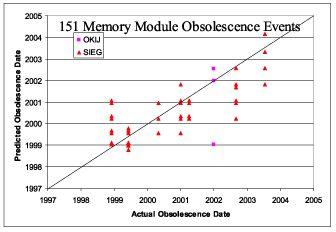
Part obsolescence dates (the date on which the part is no longer procurable from its original source) are important inputs during design planning. Studies indicate that most electronic parts pass through several life cycle stages corresponding to changes in part sales: introduction, growth, maturity (saturation), decline, and phase-out. Most electronic part obsolescence forecasting is based on the development of models for the part’s life cycle. Traditional methods of life cycle forecasting utilized in commercially available tools and services are based “scorecard” or ordinal scale based approaches, in which the life cycle stage of the part is determined from an array of technological attributes. More general models based on technology trends have also appeared including a methodology based on forecasting part sales curves, and leading-indicator approaches.
CALCE developed an obsolescence forecasting methodology based on forecasting part sales curves. In this method, sales data for an electronic part is curve fit. The attributes of the curve fits (e.g., mean and standard deviation for sales data fitted with a Gaussian) are plotted and trend equations are created that can be used for predicting the obsolescence of future versions of the part type. The trend equations predict the sales curves as a function of a primary attribute for the part, e.g., for a DRAM the primary attribute is the DRAM size (e.g., 16M). With the trend equations and a definition of the zone of obsolescence (2.5s to 3.5s to the right of the mean), the future obsolescence date for a part can be predicted. The same sales forecasting process has to be performed on secondary attributes such as bias level and package type too, and the minimum prediction of the zone of obsolescence is finally used for the part.
CALCE has also developed
a methodology for generating algorithms that can be used to predict the obsolescence dates
for electronic parts that do not have clear evolutionary parametric drivers. The method is
based on the calculation of procurement lifetime (the amount of time that a part
is available from its original manufacturer) using databases of previous obsolescence events and introduced
parts that have not gone obsolete.
The various CALCE electronic part obsolescence forecasting methodologies are described in:
|
|
P.
Sandborn, V. Prabhakar and O. Ahmad, “Forecasting Technology Procurement Lifetimes for Use in
Managing DMSMS Obsolescence,” Microelectronics
Reliability,Vol.
51, pp. 392-399, 2011. |
|
|
|
P. Sandborn, F. Mauro, and R. Knox, “A Data Mining Based Approach to Electronic Part Obsolescence Forecasting,” IEEE Trans. on Components and Packaging Technologies, Vol. 30, No. 3, pp. 397-401, September 2007. |
|
|
|
R.
Solomon, P. Sandborn and M. Pecht, “Electronic
Part Life Cycle Concepts and Obsolescence Forecasting,” IEEE Trans. on Components and Packaging
Technologies, pp. 707-713, December 2000. |
|
|
|
K.
Feldman and P. Sandborn, “Integrating Technology Obsolescence Considerations into
Product Design Planning,” Proceedings of the ASME 2007 International
Design Engineering Conferences & Computers and Information in Engineering
Conference, Las Vegas, NV, Sept. 2007. |
|
|
M. Pecht, R.
Solomon, P. Sandborn, C. Wilkinson, and D. Das, Life Cycle Forecasting, Mitigation Assessment and
Obsolescence Strategies, CALCE EPSC Press, 2002. |
|
|
The
baseline obsolescence forecasting approach uses a fixed window of
obsolescence determined as some fixed number of standard deviations from the
peak sales year of the part. An
extension to this methodology that increases the accuracy of the forecasts
and can quantitatively generate forecasts at a user specified confidence
level is the calculation of electronic part vendor-specific windows of
obsolescence using historical last-order or last-ship dates. In this way, the window of obsolescence
specification is dependent on manufacturer-specific business practices. |
MOCA Design Refresh Planning (Strategic DMSMS Management)
University of Maryland research contributions in design refresh planning optimization:
· Development of the first DMSMS strategic design refresh planning methodology/tool - MOCA (Mitigation of Obsolescence Cost Analysis)
· MOCA is supported at over 25 sites worldwide
· MOCA analyses completed for Honeywell, Northrop Grumman, Lockheed Martin, Motorola, Ortho Clinical Diagnostics, Argon ST and Army CECOM.
· MOCA is integrated with tools from Price Systems, Titan, Frontier Technologies and NSWC Crane
· MOCA was the 2002 University of Maryland Information Sciences Invention of the Year
A methodology and it’s software implementation (MOCA) has been developed for determining the part obsolescence impact on life cycle sustainment costs for the long field life electronic systems based on future production projections, maintenance requirements and part obsolescence forecasts. Based on a detailed cost analysis model, the methodology determines the optimum design refresh plan during the field-support-life of the product. The design refresh plan consists of the number of design refresh activities, their respective calendar dates and content to minimize the life cycle sustainment cost of the product. The methodology supports user determined short- and long-term obsolescence mitigation approaches on a per part basis, variable look-ahead times associated with design refreshes, and allows for inputs to be specified as probability distributions that can vary with time. Outputs from this analysis can optionally be used as inputs to the PRICE Systems PRICE H/L commercial software tools for predicting life cycle costs of systems.
MOCA refresh planning is one of the only proactive design/cost tools in the technology obsolescence area. MOCA provides planning knowledge that can be used for business case development, return on investment (ROI) analysis, risk analysis, and future budget planning.
Additional details of the model formulations and examples produced using the model can be found in the following publications:
|
R.
Nelson III and P. Sandborn, “Strategic Management of Component Obsolescence Using
Constraint-Driven Design Refresh Planning,” ASME International Design
Engineering Conferences & Computers and Information in Engineering
Conference, Washington DC, August 2011. |
||
|
R.
Nelson and P. Sandborn, “Managing Coupled Hardware and Software Obsolescence
Using Constraint-Driven Design Refresh Planning,” Proceedings DMSMS
Conference, Las Vegas, NV, October 2010. |
||
|
|
P.
Sandborn and R. Nelson III, “Constraint-Driven Refresh Planning of Systems
Subject to Obsolescence,” Proceedings DMSMS Conference, Palm Springs,
CA, September 2008. |
|
|
|
P.
Sandborn, “Strategic Management of DMSMS in Systems,” DSP Journal,
pp. 24-30, April/June 2008. |
|
|
|
J. Myers and P. Sandborn, "Integration of Technology Roadmapping Information and Business Case Development into DMSMS-Driven Design Refresh Planning of the V-22 Advanced Mission Computer," Proceedings of the 2007 Aging Aircraft Conference, Palm Springs, CA, April 2007. |
|
|
|
P.
Singh and P. Sandborn, "Obsolescence
Driven Design Refresh Planning for Sustainment-Dominated Systems," The
Engineering Economist, Vol. 51, No. 2, pp. 115-139, April-June 2006. |
|
|
|
P.
Sandborn and P. Singh, “Forecasting
Technology Insertion Concurrent with Design Refresh Planning for COTS-Based
Electronic Systems,” Proc.
Reliability and Maintainability Symposium, Arlington, VA, Jan. 2005. |
|
|
|
P.
Sandborn, "Beyond Reactive Thinking – We Should be Developing Pro-Active
Approaches to Obsolescence Management Too!," DMSMS Center of
Excellence Newsletter, Vol. 2, Issue 3, pp. 4, 9, July 2004. |
|
|
P.
Singh, P. Sandborn, T. Geiser, and D. Lorenson, "Electronic
Part Obsolescence Driven Design Refresh Planning," International
Journal of Agile Manufacturing, Vol. 7, No. 1, pp. 23-32, 2004. |
||
|
|
P.
Singh, P. Sandborn, T. Geiser, and D. Lorenson, "Electronic
Part Obsolescence Driven Design Refresh Optimization," Proc.
International Conference on Concurrent Engineering, pp. 961-970, Cranfield University, UK, July 2002. |
|
|
P.
Singh, P. Sandborn, D. Lorenson, and T. Geiser, "Determining
Optimum Redesign Plans for Avionics Considering Electronic Part Obsolescence
Forecasts," in Proc. World Aviation Congress, Phoenix,
AZ, November 2002. (SAE Technical Paper: 2002-1-3012) |
||
|
P.
Sandborn and P. Singh, "Electronic
Part Obsolescence Driven Design Refresh Optimization," in Proc.
FAA/DoD/NASA Aging Aircraft Conference, San Francisco, CA, September
2002. |
||
|
MOCA
(Mitigation of Obsolescence Cost Analysis) software tool wins 2002 University
of Maryland Information Sciences Invention of the Year (April 28, 2003) |
Members of the CALCE Consortium and others involved in research projects at the University of Maryland can download the MOCA software and documentation. Contact Peter Sandborn for access to MOCA.
Lifetime Buy
Forecasting (Life of Type - LOT Buy, All Time Buy)
Lifetime buy is one of the most prevalent obsolescence mitigation approaches employed in the DMSMS management community. Purchasing sufficient parts to meet current and future demands is simpler in theory than practice due to many interacting influences and due to the complexity of multiple concurrent buys. The lifetime buy problem has two facets, demand forecasting and optimizing lifetime buy quantities based on the demands forecasted.
|
Members of the CALCE Consortium can download a stochastic quantity forecasting tool from: Download lifetime buy quantity forecasting tool (public,
no CALCE login needed). |
Stochastic
Quantity Forecasting
The
inputs to the model are:
The
outputs from the model are:
|
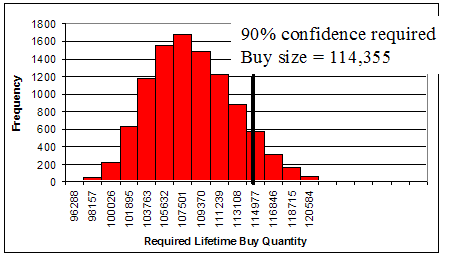
The stochastic lifetime buy quantity forecasting
tool shown above calculates the quantities of parts necessary to meet a given
demand with a specified confidence and only treats one part at a time.
Alternatively, one can calculate the quantities of parts necessary to minimize
life cycle cost (depending on how you are penalized for running short or
running long on parts these quantities could be different than what the
stochastic lifetime buy quantity forecasting tool gives). In order to work the
cost minimization problem, multiple factors that contribute to lifecycle cost must be considered: procurement cost, inventory cost,
disposition cost, and penalty cost. Each of these costs has its own
contributing elements. For example, penalty cost is a summation of the
alternative sources availability cost, system unavailability cost, inventory
shortage cost, equal run-out cost, and more.
|
|
|
More information on CALCE lifetime buy analyses can be found in:
|
|
D.
Feng, P. Singh, and P. Sandborn, "Optimizing Lifetime Buys to Minimize Lifecycle Cost,"
Proceedings of the 2007 Aging Aircraft Conference, Palm Springs, CA,
April 2007. |
|
|
|
P. Sandborn, V. Prabhakar, and D. Feng, "DMSMS Lifetime Buy Characterization Via Data Mining of Historical Buys," Proceedings DMSMS Conference, Orlando, FL, November 2007. |
|
There are a growing number of
methodologies, databases and tools that address status, forecasting, risk,
mitigation and management of technology obsolescence. The one
common attribute of all the methodologies, databases and tools that are in use
today, whether reactive, proactive or strategic, is that they focus on the
hardware life cycle. In most complex systems, software life cycle costs
(redesign, re-hosting and re-qualification) contribute as much or more to the
total life cycle cost as the hardware, and the hardware and software must be sustained together.
|
R.
Nelson and P. Sandborn, “Managing Coupled Hardware and Software Obsolescence
Using Constraint-Driven Design Refresh Planning,” Proceedings DMSMS Conference,
Las Vegas, NV, October 2010. |
||
|
|
P.
Sandborn, "Software Obsolescence - Complicating the Part and Technology
Obsolescence Management Problem," IEEE Transactions on Components
and Packaging Technologies, Vol. 30, No. 4, pp. 886-888, December 2007. |
|
|
|
P. Sandborn and G. Plunkett, "The Other Half of the DMSMS Problem - Software Obsolescence," DMSMS Knowledge Sharing Portal Newsletter, Vol. 4, Issue 4, pp. 3 and 11, June 2006. |
|
A taxonomy and evaluation criteria for organizing and assessing DMSMS tools, databases, and services has been developed. These activities are useful in the short term to assess the state of the present DMSMS management tools and the gaps that may be present within them; and necessary in the longer term to lay the ground work for constructing an ontology that will be necessary to achieve web-centric, enterprise-wide DMSMS management solutions.
|
L. Zheng, R. Nelson III, J. Terpenny,
P. Sandborn, Ontology-Based Knowledge
Representation for Product Life Cycle Concepts and Obsolescence Forecasting, the 2011 Industrial Engineering Research Conference (IERC), Reno,
Nevada, May 21-25, 2011 |
||
|
|
P. Sandborn, R. Jung, R. Wong, and J. Becker, "A Taxonomy and Evaluation Criteria for DMSMS Tools, Databases and Services," Proceedings of the 2007 Aging Aircraft Conference, Palm Springs, CA, April 2007. |
|
|
|
P.
Sandborn, “DMSMS Tool Evaluation,” CALCE Report Number C06-43,
2006. |
|
Business Cases and Return on Investment Analysis for Obsolescence Management
Cost models are needed so
that the ramifications of system design, material, technology, part, and
architecture decisions on sustainment costs can be clearly understood during decision making, and the value of later management actions
can be clearly established. To influence strategic decisions about the
management of systems, predictive models are needed that can provide engineers
with information that they can use to develop sound proposals (i.e., support
for business cases) to influence program-level management.
|
P.
Sandborn, “Making Business Cases to Support Obsolescence Management”. conference keynote address at the 7th Component
Obsolescence Group (COG) International Conference, York England, June 29,
2011. White Paper |
||
|
|
P.
Sandborn, “Calculating the Return on Investment for DMSMS Management,”
Proceedings DMSMS Conference, Las Vegas, NV, October 2010. |
|
|
|
P. Sandborn, “Strategic Management of DMSMS in Systems,” DSP Journal, pp. 24-30, April/June 2008. |
|
Critial Human Skills Obsolescence
The loss of critical human skills that are either non-replenishable or take very long periods of time to reconstitute, impacts the support of legacy systems ranging from infrastructure, military and aerospace to IT. Many legacy systems must be supported for long periods of time because they are prohibitively expensive to replace. Loss of critical human skills is a problem for legacy system support organizations as they try to understand and mitigate the effects of an aging workforce with highly specialized, low-demand skill sets. The existing research focuses on workers that have skills that are obsolete and therefore need to be retrained to remain employable; alternatively our work addresses the system support impacts due to the lack of workers with the required skill set. We developed a model for forecasting the loss of critical human skills and the impact of that loss on the future cost of system support. The model can be used to support business cases for system replacement.
|
P. Sandborn and V.J. Prabhakar, “Forecasting and Impact of the Loss of the Critical Human Skills Necessary for Supporting Legacy Systems,” IEEE Transactions on Engineering Management, Vol. 62, No. 3, pp. 361-371, August 2015. |
Viability (Technology Insertion) - Viable Combat Avionics, Avionics Viability
Product sustainment means keeping an existing system operational and maintaining the ability to continue to manufacture and field versions of the system that satisfy the original requirements. Sustainment also includes manufacturing and fielding revised versions of the system that satisfy evolving requirements – this often requires that the technologies used to construct the system evolve as well. Technology insertion involves determining which technologies to replace during a design refresh, i.e., deciding the design refresh content, and deciding when that design refresh should take place. Technology replacement decisions are driven by a broad range of issues including performance, reliability, cost, and logistics, and when, or if other design refreshes will take place.
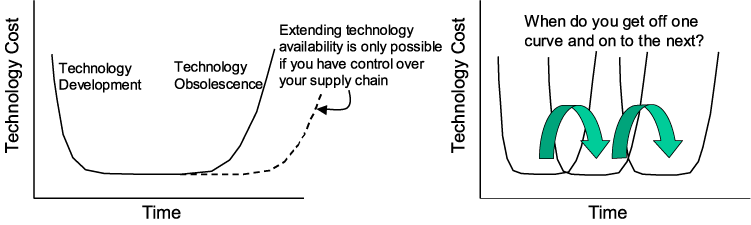
Supporting
systems and evolving requirements.
Traditional “value” metrics go part of the way toward providing a coupled view of performance, reliability and cost, but are generally ignorant of how product sustainment may be impacted. A metric that measures both the value of the technology refreshment and insertion, and its ability to support both the system’s current and future affordability and capability needs including hardware, software, information and intellectual property is required. Viability is a measure of the producibility, supportability, and evolvability of a system and can serve as a metric for assessing technology insertion opportunities.
|
P.
Sandborn, T. Herald, J. Houston, and P. Singh, "Optimum Technology Insertion into Systems Based on the
Assessment of Viability," IEEE Trans. on Components and Packaging Technologies, Vol. 26, No.
4, pp. 734-738, December 2003. |
||
|
P.
Sandborn and J. Myers, "Designing Engineering Systems for Sustainment," Handbook
of Performability Engineering, ed. K.B. Misra, Springer, pp. 81-103, London, 2008. |
Electronic Part Obsolescence Short Course
The Electronic Systems Cost Modeling Laboratory offers a 1 day industry short course on electronic part obsolescence. The course is divided into 6 sections that cover:
- Introduction
to Electronic Part Obsolescence
- Electronic
Part Obsolescence Forecasting
- Electronic
Part Obsolescence Mitigation
- Obsolescence Management Plan and Case Resolution
- Strategic
Obsolescence Management
- Software Obsolescence
- Electronic Part Total Ownership Cost
The course includes a review of commercial databases and associated decision support tool offerings.
Contact Peter Sandborn at CALCE at the University of Maryland for more information.
Portions of the material linked to this web site is based upon work supported by the National Science Foundation under Grant Nos. DMI-0438522 and CMMI-928628
Last
updated: July 14, 2019